This is the configuration guide to Ultimate Forms Alerts: every major setting, what it does, and when to use it, with worked setups you can copy. Alerts replace the retired SharePoint alerts and go far past them: recipients of any kind, conditions on any columns, timing driven by dates and schedules, three delivery formats, and fully designed templates, all configured from dropdowns. If you are deciding whether to adopt the engine, start with the replacement guide; if you are sitting in front of the settings screen, this page is the map.
Where alerts live
Once Ultimate Forms is installed, alert creation is available from any list or document library toolbar, replacing the old Alert Me experience with the full interface, and from within the form configuration itself. Administrators manage all alerts centrally, including alerts created by and for other users, which is what keeps a tenant's notification landscape governable rather than archaeological.
Recipients: anyone, in any role
The recipient model is wider than any native mechanism offered:
- SharePoint users and groups, the familiar case
- Distribution lists, for team-wide delivery without maintaining duplicates
- Users in a column, so the alert addresses whoever the item says, the assignee, the manager, the owner, resolved per item
- Contacts stored in a list, for recipient sets maintained as data
- Typed email addresses, including external ones, so customers and vendors receive notifications without accounts
Each alert distinguishes To, CC, and BCC, and a Do not send list excludes specific people even when a group or column would otherwise include them, the quiet setting that prevents the CEO from receiving every ticket update. Column-based recipients are the workhorse: they turn one alert into per-item routing with nothing hardcoded.
Conditions: when the alert deserves to fire
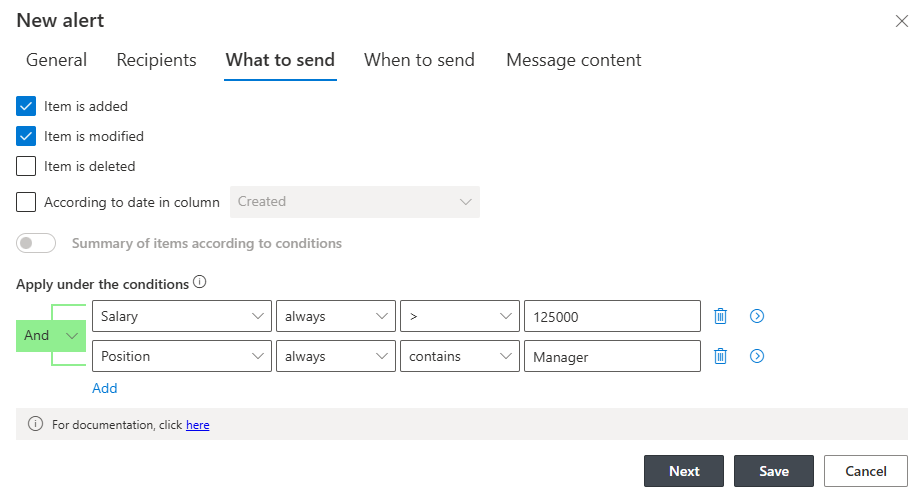
Conditions combine any column values, so the alert fires on meaning rather than on motion. Order Amount greater than 5,000. Pipeline status equals At Risk. Status has changed to Submitted, the integration with form-driven processes means stage transitions, not edits, are what notify. The test for every condition set: would the recipient act on this email? If not, tighten until they would, because unnecessary notifications train people to skim the necessary ones.
Timing: immediate, date-driven, or scheduled
Immediate delivery is the default and right for genuine urgency. The two other modes are where the engine earns its keep.
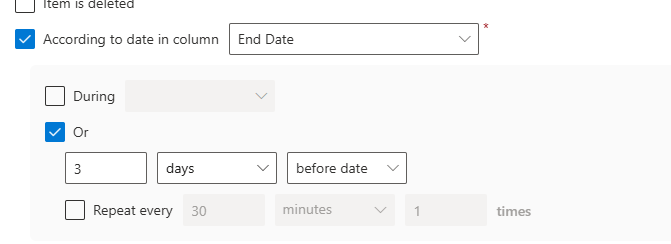
Date-based alerts key off any date column. Choose According to date, pick the column, and set the relationship: a set time before the date (one day before Due Date), on the date itself, after it, or repeating until a condition clears, the daily nudge until the task completes. Shorthand ranges, Today, Tomorrow, This Week, cover the common cases without building date arithmetic. This is the mechanism behind deadline reminders and renewal warnings, and with repetition it becomes timer-based chasing that never forgets.
Postponed and scheduled delivery batches alerts daily or weekly instead of sending each immediately, with after-hours events held for the next business day. Batching is not a compromise; for most recurring information it is the better product, one organized digest instead of a stream of pings.
Delivery formats: three shapes of message
Batched alerts choose their shape:
- Separate messages: one email per item, each carrying the full template. Right when each item demands individual attention.
- Single combined message: all items in one email, full detail per item. Right for a handful of substantial updates.
- Summary mode: one line per item in a clean list, with customizable subject, item template, headers, and footers. Right for volume, the daily task list, the weekly events overview, where scannability beats detail.
Choosing the format per alert, rather than accepting one global behavior, is a small setting with outsized effect on whether recipients keep reading.
Templates: emails worth opening
The rich text editor designs the message: branding, formatted item data with dynamic columns like [Title] and [Due Date], images, and links back to the item, list, or site. Attachments can ride along, and action buttons execute decisions straight from the inbox, approvals without opening SharePoint, with parameterized buttons collecting input as they act.
Templates can be configured for each alert or reused. Reusable templated are managed by administrators for everyone, so the organization's notifications look and read consistently. What the template should say is its own craft; the four rules of alert emails that get read cover it.
The advanced drawer
Settings that surface once alerts multiply: alert grouping consolidates several alerts into one email; pause and resume disables an alert without deleting its configuration, the right move during migrations and bulk updates; dynamic recipient lists from columns were covered above but combine with everything; and central logging records every sent message for governance, the answer to "did the system actually notify them" asked by every dispute. Delivery itself has its own operational guide in ensuring seamless alert delivery, and admins should know the email delivery changes that affect senders tenant-wide. Alerts also deliver to Teams chats and channels, with mentions resolved from Person columns, and users can subscribe themselves from inside the form.
Three setups to copy
Daily task reminders. Condition: Due Date is tomorrow or overdue. Schedule: daily at 8:00 AM. Format: summary mode. Recipients: the Assigned To column. Each person gets one scannable morning email of their own workload, and nobody else's.
Contract expiration watch. Condition: End Date within 30 days and Status is Active. Schedule: weekly, Mondays 9:00 AM. Format: combined message. Recipient: the Contract Manager column. The renewal conversation starts on time, every time, the pattern the contract approval workflow builds on.
Inventory reorder notices. Condition: Quantity below Reorder Threshold. Schedule: daily at 7:00 AM. Recipients: the purchasing team. Restocking becomes proactive, driven by the data instead of by the person who noticed the shelf.
And the weekly events digest, step by step: new alert on the events list; condition Start Time is this week; weekly schedule on your chosen day and hour; summary mode; customize the summary subject and headers under Administration; save. Every week, one polished overview of the week ahead, assembled by nobody.
Designing an alert portfolio, not just alerts
One habit separates tenants where notifications work from tenants where they are wallpaper: treat the full set of alerts on a list as one portfolio with a budget. Each recipient should get at most one immediate alert type (the thing they must act on now), one digest (the things they should know today), and one date-driven reminder stream (the deadlines that are theirs). Everything else is a candidate for conditions, consolidation, or deletion. When a new request arrives, "can we get notified when...", the first question is which of the three existing slots it belongs to, not whether to create alert number eleven. Portfolios stay readable for years; accumulations do not.
The setup sequence
For any alert, the same nine decisions in order: install Ultimate Forms if needed; create the alert from the list toolbar; choose what to send (events or date logic); set the conditions; set the timing (immediate or postponed); choose the recipients (static or from columns); pick the format (separate, combined, summary); design or select the template; save and test with a real change. The test matters: fire the alert once and read it as its recipient before trusting it with the process.
Alerts pair with the rest of the platform, Actions for the doing, Alerts for the telling, and the replacement guide covers the migration path, the Power Automate comparison, and the strategy above this configuration layer.
Frequently asked questions
Add your comment