Four rules separate a SharePoint alert email that gets acted on from one that gets archived unread: put the key information in the subject line, keep the body to what happened and what happens next, end with a single next-step link, and format that link to look like a button. None of them require code or special tools, they are writing and formatting decisions made once, when the alert is configured, and they pay on every email the alert ever sends. This article explains each rule and walks through the button formatting step by step.
The configuration of an alert determines whether it sends. The writing determines whether it works.
Your emails are being ignored
Everyone knows that forms trigger emails, and when setting up email alerts for SharePoint we spend almost no time thinking about the content. Something gets thrown together quickly, a link goes at the bottom, done. That is exactly the problem: we give alert emails little thought, and the people receiving them give them even less. Most SharePoint notifications look boring and unimportant, and in inboxes already buried in email, boring and unimportant means ignored.
The cost is not cosmetic. An ignored approval notification is an approval that waits; an ignored task alert is a deadline missed quietly. The process moves at the speed of the people who know it is their turn, and the email is how they find out. (Our companion piece, Nobody's Reading Your Stupid Automated Emails, makes the same argument with less diplomacy.) The good news is that the fix is a matter of craft, not technology, and the craft reduces to four rules.
Rule 1: The subject line is the email
Many users only read the subject line, so the subject line must carry the payload: clearly define what happened, to what, and what is expected. Compare "Item modified in Purchase Requests" with "PR-1174 approved: order laptops by Friday." The first requires opening the email to learn anything; the second has already communicated even if the email is never opened.
The practical technique is to build subjects from column values rather than static text: the request number, the requester, the amount, the new status. An alert configured once with dynamic values produces a specific, scannable subject on every send, and specific subjects also make emails findable in search a month later, which generic subjects never are.
Rule 2: Cut out the fat
Respect the time of your users. The body should describe only what happened and what happens next; everything else lives in SharePoint, one click away. The instinct to dump the whole item into the email, every field, every value, produces a wall the recipient skims past, and you lose your audience along with the result you wanted. The detailed information is in SharePoint; it does not belong in your email.
A useful discipline: draft the body as two short lines, what changed, and what the recipient should do about it, then stop. If a field's value is essential to the decision (the amount on an approval, the deadline on a task), include that field and no others. When the audience genuinely needs a lot of information regularly, the answer is not a longer email but a different format entirely, a daily summary that consolidates many changes into one organized message.
Rule 3: Every email is a call to action
Each alert email exists because someone should do something, so make the next step effortless: always end the email with a link that performs it. Usually that is a link to the edit form or display form of the item in question; sometimes it is a link to the SharePoint list. What matters is that the recipient never has to figure out where to go, the email did that thinking for them.
One link, singular, is the discipline. An email offering three links makes the recipient choose, and choice is friction. Decide which single action the process wants and give that action the spotlight.
Rule 4: Make the link look like a button
Why format the link? Because we are borrowing a technique from email marketing: we are conditioned to take action by clicking a button. A styled button-look draws the eye, signals "this is the point of this email," and measurably improves response over a bare text link, which reads as optional.
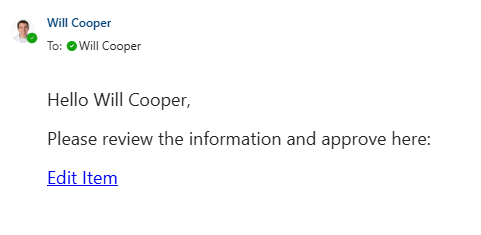
Here is a typical unformatted link at the bottom of an alert email. It is not eye catching, and it seems skippable:
Turning it into a button takes a few steps in the content editor:
- Highlight the link and set the font size to 24px.
- Set the text as bold.
- Choose a background color for the link.
- Add three spaces before and after the link text to provide padding.
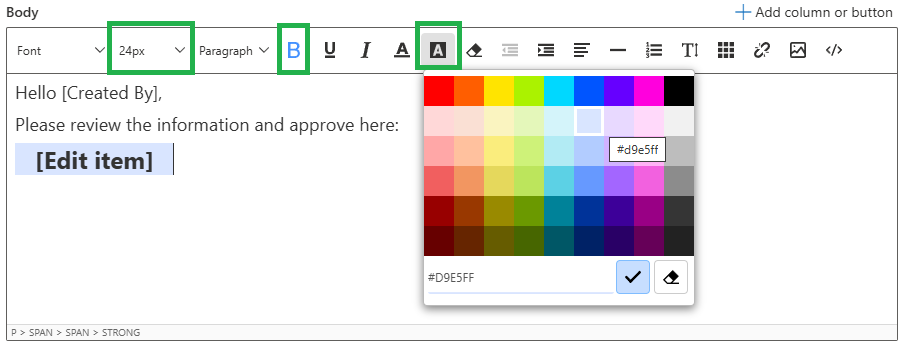
A few extra seconds of formatting produces a button-style link that stands out and pulls the eye exactly where you want the click:
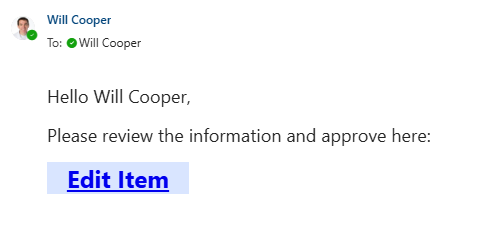
Choose the background color deliberately: your brand color for routine actions, and reserve anything alarming for alerts that are genuinely urgent, so color keeps meaning. And when you are ready to go one step further, Ultimate Forms alerts support real action buttons that perform the update directly from the inbox, approve without even opening SharePoint, which is the same principle carried to its conclusion.
The fifth rule nobody writes down: send less
The four rules make each email better; the surrounding discipline makes the whole system credible. Every unnecessary email an alert sends teaches recipients that your notifications can be skimmed, and that lesson transfers to the necessary ones. Use conditions so alerts fire on the changes that matter, a status reaching a threshold, an assignment changing, not on every edit of every field. Use digests where volume is inherent. The recipient who gets three sharp emails a week from your system reads all three; the one who gets thirty vague ones reads none. Writing better and sending less are the same project: raising the value of the average email that carries your name.
For the design half of the story, branding, layouts, reusable templates shared across the organization, see our guide to designing alert email templates; the four rules here govern what the words say, and the template governs how they look. In summary, for best results: put all key information in the subject line, include only essential information in the body, provide a next-step link at the bottom, and format that link to stand out. Your users will appreciate the streamlined information, and your emails will get the results they were sent for. Remember, all the information is already in SharePoint; your users will click the link when they need more.
Frequently asked questions
Add your comment