A signed form that cannot leave SharePoint as a signed document is only half a solution. The approval happened, but the contract you email, print, or archive does not show it.
Two components of Ultimate Forms close the loop together. The Signature column captures the signature on the form and binds it to the data. The Print component renders the record as a professional document, with the signature visibly in it. The result is a PDF that looks the way signed paperwork has always looked, backed by integrity checks paper never had.
This guide covers how the two work together, the documents that need them, and the four setup steps. For the full output system around it, see the complete document generation guide.
The signature on the form
The Signature column is a special column type you add to any list or library. A person signs the item, and the signature is cryptographically tied to the data it covers.
Signing can cover the whole item or only chosen columns: the approval status, the financial figures, the decision. That choice matters in staged processes, where the signature should protect what was decided without freezing every later edit.
Three signing methods are available. Username and password, validated in real time. A declarative signature, where the signer confirms a statement. And a handwritten signature, drawn on the device screen, which is the one this article's print story centers on.
Integrity is the point of all three. If anyone edits a signed value afterwards, the signature visibly breaks, on the form and in list views alike. Across a large list, valid and broken signatures read at a glance, so an unauthorized change cannot hide. This is the record-keeping that standards in healthcare, pharmaceuticals, quality management, and data protection keep asking for: who signed, what exactly they signed, and proof it has not changed since.
The component's full depth, validation methods, column coverage, and the regulated-industry angle, lives in the electronic signatures guide. Here, the signature is the input. The document is what we are after.
The document that shows it
Most signed records eventually face someone outside the list. The client gets the contract. HR files the evaluation. The auditor receives the consent record. At that moment, a raw list item is not enough. The output needs to be a document, and the signature needs to be on it.
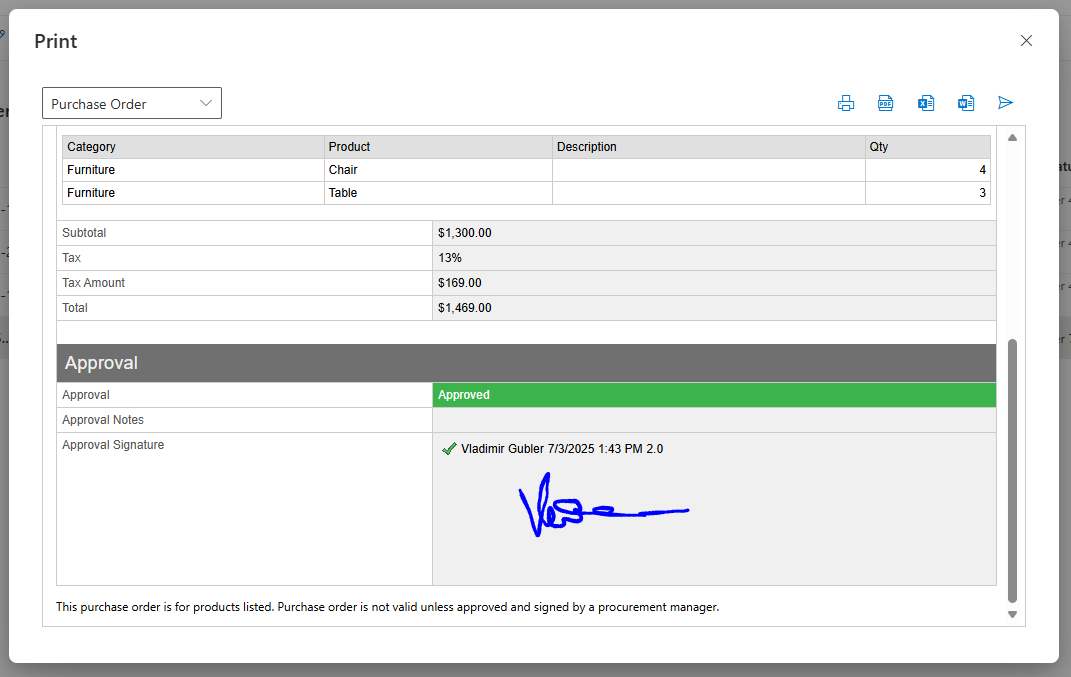
The Print component renders the item through a template: your branding, headers and footers, the columns laid out as a real document, exported to PDF or Word. Place the Signature column in the template where a signature block belongs, and the output carries it.
For handwritten signatures, that means the actual drawn signature image, embedded in the print preview and in the exported PDF, exactly where a signature sits on paper. The recipient sees a signed document in the only sense they have ever understood one. Alongside it travel the details that make it better than paper: who signed, when, and the integrity status of the signed data.
The emailed version behaves the same way. Send the print template as a PDF attachment, and the recipient receives the complete signed document, no SharePoint access required.
Where this pattern runs
Contract approvals. The client or employee signs on the form. The contract goes out as a formal PDF with the signature visible. The version you sent is the version they signed, and the broken-signature check guards the record behind it.
Employee evaluations. The supervisor signs off with a handwritten signature. The evaluation prints into the HR file, or emails to the employee, as official documentation rather than a screenshot of a list.
Purchase orders and invoices. Finance documents carry their authorization visibly. Each one generates from the list through the same template, so the archive is consistent and every document in it is signed.
Consent and clinical records. Patient or physician consent is captured on the form and leaves as compliant, printable documentation, with the signed data's integrity verifiable at any later date.
The common shape: the signature is captured once, digitally, and every document that needs it inherits it. Nobody prints, signs, and rescans anything.
Processes with several signers follow the same pattern. A list can carry more than one Signature column, the requester's and the approver's, say, each covering its own columns and gated by its own permission rules. The template places each block where it belongs, and the printed document shows the full chain of signatures, just as the paper version would.
Setting it up
Four steps cover the whole build.
Step 1: confirm the components. On Microsoft 365, everything ships with Ultimate Forms. On premises, make sure both the Signature column and Print are part of your installation.
Step 2: add the Signature column. Open the list, click Design, and add a new Signature column. Decide what it signs: the whole item or specific columns. Pick the signing method: username and password, declarative, or handwritten. Then use permission rules to control who can sign and at which stage, so the signature arrives exactly when the process expects it.
Step 3: build the print template. Create a template with placeholders for the columns the document should show. Place the Signature column where the signature block belongs. Enable PDF export, and email delivery if the document should send itself. The designed-reports guide covers making the template genuinely polished.
Step 4: test the round trip. Sign a test item with the chosen method. Print it, export the PDF, and confirm the signature appears where it should. Then edit a signed value on the test item, and confirm the broken-signature warning shows. That second test is the one people skip, and the one auditors ask about.
From there, delivery can be automated. An action generates and emails the signed document the moment the record reaches its final state. So the signed PDF is a process step rather than a task.
Two signatures, one trustworthy document
It is worth being precise about what this article's signature proves, because a second, different seal exists in the same product.
The electronic signature on the item proves a person agreed: the approver, the client, the physician. It lives in the data, renders in the document, and breaks if the signed data changes.
The digital signature on the PDF proves the organization issued this exact file: a certificate on the print template seals every export, and any alteration to the file flags in the reader.
They answer different questions, and formal documents often need both. The approver's signature inside the page says the decision was made. The certificate's seal on the file says the document is authentic and untouched. Configured once each, every generated document carries both automatically.
That is the full journey this cluster keeps describing: data lives in the list, decisions are signed where they happen, and what leaves is a document that shows its signatures and defends its integrity, generated by the same machinery as everything else you print.
Frequently asked questions
Add your comment