A SharePoint calendar can leave the screen exactly as it looks on it: the Calendar component of Ultimate Forms prints and exports to PDF with every setting preserved, the active filters, the color coding, the chosen view from day through year to Gantt, and can email the result as an attachment or inline. One click opens the preview; print, save, or send from there. This guide covers what makes the calendar worth printing in the first place, what the output carries, and where paper and PDF calendars still run the show. For the output machinery behind it, see the complete document generation guide.
The calendar worth printing
Printing matters here because the Calendar component is not a single list's events on a grid. It aggregates sources, SharePoint lists and libraries, Exchange calendars, and external databases, into one consolidated view, filters by source, category, and column values, color-codes by source, category columns, or Color Choice values, and renders in eight modes: day, week, work week, month, quarter, half-year, year, and Gantt. The screen version is the operational one; the printed version is the same assembly, frozen at a moment, which is exactly what briefings, postings, and records need, and why printing a rich calendar beats rebuilding its content in a slide.
What makes the export genuinely useful is the fidelity rule: the output matches the screen. The filters applied stay applied, the color coding carries over, the selected view mode is the printed layout. There is no separate print configuration to maintain and no gap between what the planner saw and what the stakeholder received, the same what-you-see-is-what-you-get economy that runs through form printing without templates, applied to schedules.
One click, four destinations
With the Print button enabled in the Calendar settings, the workflow is a single click into a print preview styled as the web part itself, and from the preview, four exits: print directly from the browser; save as PDF for filing and distribution; email as a PDF attachment; or email inline, the calendar as the message body, for recipients who should see the schedule without opening anything:
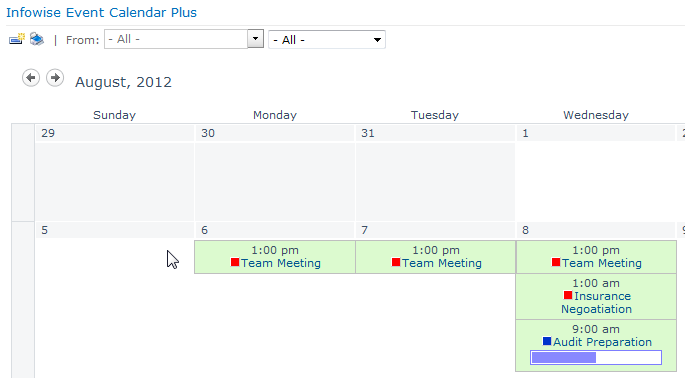
The email paths deserve the emphasis, because they serve the audience that justifies printing at all: the people outside the daily SharePoint flow. Partners, contractors, and executives receive a clean snapshot of exactly the slice of the schedule meant for them, the filtered view does the scoping, with no accounts, no links, and no "can you give me access."
Choosing the view for the audience
The eight view modes are eight different documents, and matching mode to audience is most of the craft. The month view is the general-purpose handout, the schedule people pin up and photograph. Week and work week suit operational handoffs, the shift plan, the room schedule, the field crew's docket. Quarter through year serve planning and leadership: the training calendar for the year, the audit schedule, the release cadence, compressed to the shapes long-range discussions need. And the Gantt view is the project document: a timeline of events with their dependencies visible, and, when events carry associated tasks, the tasks and their progress print within it, so the exported Gantt shows not only when things happen but how far along their work is, the one-page project status that project management, campaign planning, and event preparation keep asking for.
Color does the second half of the communication. Categories, departments, statuses, and sources distinguish themselves at a glance on paper exactly as on screen, which is what lets a single printed month carry three teams' schedules legibly. The craft note from every printed-color context applies: colors chosen for the screen should be checked once on paper, where lighter fills and higher contrast photocopy better, and the calendar's category palette is worth settling with the printout in mind.
Where the printed calendar runs the show
The posted schedule. Workshops, clinics, kitchens, and front desks run on wall schedules, and a filtered, color-coded month printed from the live calendar replaces the hand-maintained whiteboard with something that is both current and attractive. When the schedule changes, reprint; the source was always the system.
The stakeholder briefing. The executive review, the client update, the committee pack: a quarter or half-year view exported to PDF drops the schedule into the deck or the pack in one motion, already filtered to the audience's concerns.
The compliance record. Inspection programs, maintenance schedules, and training calendars often must be demonstrable: what was planned, for when. A dated PDF export of the calendar is the planning snapshot auditors ask for, filed in the library beside the records it governs, and the practice pairs naturally with the audit-trail machinery covering what then happened.
The offline fallback. Field operations, events, and facilities work where connectivity is a maybe, and the printed day or week in a pocket is the schedule that cannot lose signal. The same logic covers the business-continuity drawer: the current on-call calendar, printed monthly, exists precisely for the day the systems do not.
Across all four, the setup cost is the one-time minute of enabling the Print button, after which exporting is part of using the calendar rather than a project of its own, and the deeper calendar craft, building the views and sources well, pays off twice, on screen and on paper.
The snapshot discipline
One practice turns calendar printing from a convenience into an institution: date the exports and keep them. A calendar is the rare record that describes the future, and the future gets revised, which means yesterday's export is evidence of what was planned before the revision. Teams that file a dated PDF at each planning milestone, the quarter's schedule as approved, the event program as published, the maintenance plan as committed, acquire an archive of intentions that answers the questions revisions always raise: what moved, when, and from what. The filing itself can be nobody's job; printing to a library with a dated filename takes seconds at the moment the plan is settled, and the naming convention, the period plus the date of the snapshot, lets the archive sort itself. Six months later, the difference between "we think the schedule changed in March" and a folder of dated snapshots is the difference between recollection and record.
Getting it running
Four steps cover the whole setup. Install the Print component, part of Ultimate Forms alongside Calendar. Enable the Print button in the Calendar web part's settings. Configure the calendar as the audience should see it, sources, filters, color coding, default view, since the print inherits all of it. Then click Print, and the preview opens with its print, PDF, and email options ready. From there the only recurring decision is the one this article has been about: which view, filtered how, for whom, and the calendar's own controls answer it before every export. The first printout worth making is the one your team currently maintains by hand, the wall schedule, the meeting handout, because replacing a manual artifact with a one-click export is the demonstration that recruits everyone else.
Frequently asked questions
Add your comment