SharePoint forms can ask AI questions about their own data. The AI Answer function in Ultimate Forms takes text from your form, usually a multiple lines of text column, plus a question you write in plain language, and returns the answer: a summary, a priority, a sentiment score, anything the text can support. It works in forms, actions, alerts, and import profiles, with no code anywhere. This guide explains how the function works, walks through four working examples from a support form, and shows how to move from button clicks to fully automatic values.
What the AI Answer function is
The idea is the one you already know from AI chat tools: provide some text, ask a question about it, get an answer. AI Answer packages that exchange as a function inside Ultimate Forms, so the text comes from your SharePoint data and the answer lands wherever you need it.
The function lives in the Functions menu of the Value Picker, which means it is available anywhere the Value Picker is: forms, actions, alerts, and import profiles. That placement matters more than it first appears. The same function that summarizes a description when a user clicks a button can also categorize incoming records during an import, or enrich the text of an alert email, with the identical syntax in every location.
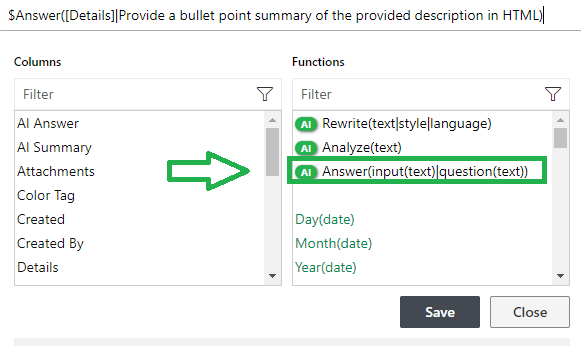
Using it takes two inputs. The input text: usually a column reference, such as the Description column of your request. And the question, written as an ordinary sentence. No formula language, no API configuration, no connectors. If you can phrase the question to a colleague, you can phrase it to the function.
The syntax in one line
The function call follows one pattern:
$Answer([Details]|Provide a bullet point summary of the provided description in HTML)
The first part references the column holding the text. The second part is the prompt. Replace [Details] with your own column name, and write the question your process needs. Everything else in this article is variations on that single line.
Example 1: a one-click summary
The demonstration form is a customer support ticket. The user describes a problem in a Details column, sometimes briefly, sometimes in a wall of text. The support agent wants the short version.
Place a button control on the form and attach the function call above. The agent clicks the button, and a bullet point summary appears almost immediately, formatted in HTML because the prompt asked for it.
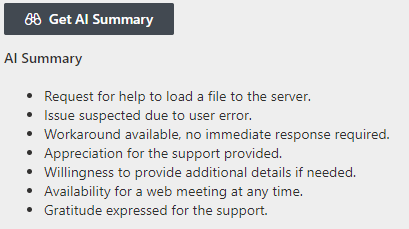
Notice what the prompt does besides asking. It specifies the output format. That is the habit worth forming from the first example: tell the function not just what to answer, but what shape the answer should take. A format instruction in the prompt saves a cleanup step after it.
Example 2: let the user ask the question
A fixed prompt covers the common case. Sometimes the agent has a question of their own: what product version does the customer mention, did they already try restarting, is there an error code in all this text.
Buttons accept input parameters, and parameters can feed the prompt. Define a text input on the button, name it Question, and change the call to:
$Answer([Details]|[@Question])
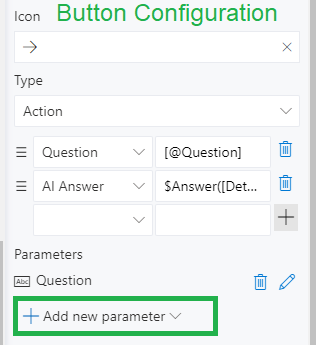
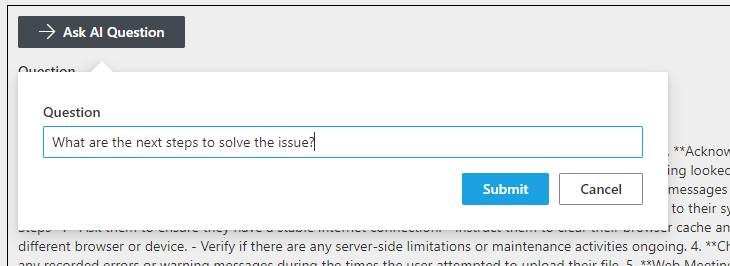
Now the button asks the agent for a question each time it is clicked, and the answer reflects whatever was asked. One button, unlimited questions, and still not a line of code: the parameter syntax is the same mechanism buttons already use for ordinary manual action parameters.
Example 3: let AI assign the priority
The first two examples inform a human. The next two produce values your process can act on.
Support tickets need a priority, and users are famously unreliable at setting it: everything is urgent to the person writing it. Let the function read the description instead:
$Answer([Details]|Based on the description evaluate urgency providing back one of three values "High", "Medium" or "Low".)
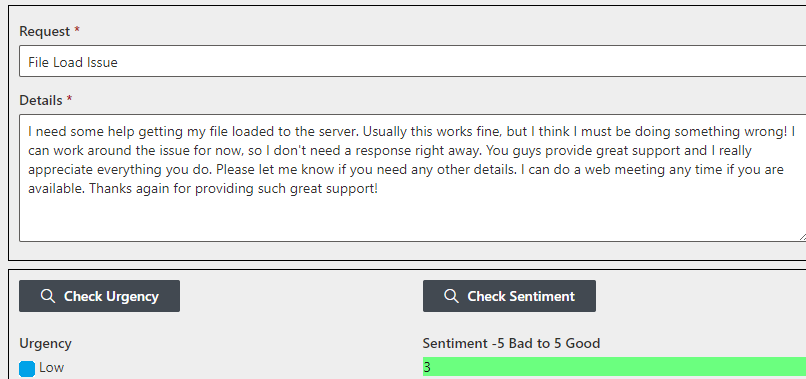
The prompt constrains the answer to exactly three values, which is what makes the result usable. A free-text answer would need interpreting; a closed list drops straight into a choice column. Routing rules, alerts, and dashboards can then treat the AI-assigned priority like any other column value, because that is what it is.
Example 4: measure the customer's temperature
The same text carries a second signal: how the customer feels. The term for this is sentiment, and the function can score it:
$Answer([Details]|Based on the description, evaluate sentiment on a scale of "-5" being very unhappy to "5" being very happy. Provide back only a single number response with values from "-5" to "5".)
A ticket scored at -5 deserves different handling than one scored at 2, even at the same technical priority. An escalation rule that watches for low sentiment catches the furious customer before the first reply goes out. Again the prompt pins the output, a single number in a known range, so the value plugs directly into conditions and views.
Beyond buttons: automatic values
Buttons are the easiest way to learn the function, but they are the least of it. The function works anywhere the Value Picker does, which opens three progressively more automatic patterns.
In form value rules, the function runs without a click. A rule can populate a Summary column whenever the column value is updated, so every item carries its digest from the moment it exists.
In actions, the function runs with no user present at all. An action triggered on item creation can read the description, assign the priority, score the sentiment, and write all three values before anyone opens the item. Combined with action conditions, the scores it produces can route the item in the same breath: high priority to the senior queue, low sentiment to a team lead.
In import profiles, the function processes records as they arrive from outside. Emails imported into a request list can be summarized and categorized during the import itself, so the list never contains an unclassified item. For inbound processes built on email import, this turns a raw mailbox feed into triaged, scored records automatically.
The progression is worth planning deliberately. Start with a button, so people see the answers and learn to trust them. Move to rules when the answers prove consistent. Finish in actions and imports, where the function does its quiet best work: filling in the values nobody enjoys assigning by hand.
Writing prompts that behave
A few practices keep results predictable in a business process.
Constrain the output whenever the value feeds logic. Name the allowed values, as the priority example does, or the exact format, as the sentiment example does. The difference between "evaluate urgency" and "provide back one of three values" is the difference between an opinion and a column value.
Keep one question per call. A prompt that asks for priority and sentiment and a summary in one answer returns a blob you then have to parse. Three calls into three columns stay clean forever.
And review the early results the way you would review a new employee's work. The function is fast and tireless, but your process owns the outcome. A week of spot-checking buys long-term confidence, and prompts are trivially easy to refine when a phrasing turns out to be ambiguous.
Frequently asked questions
Add your comment