A printed SharePoint item can bring its documents with it. The Print component includes attachments three ways: embedded directly into the generated PDF, where supported types become pages of the one file, delivered alongside the output as email attachments, or added automatically as a standard set, the terms and conditions that must accompany every export, configured once at the template level. This guide covers where the attached documents can come from, the three inclusion paths, and the standard-documents capability that ends the ritual of attaching the same files by hand. For the generation system underneath, see the complete document generation guide.
The document that travels incomplete
Generated documents usually describe something that has evidence: the expense report has receipts, the inspection has photos, the contract has exhibits, the mortgage summary has disclosures. Generate the summary without its evidence and the recipient gets half a package, with the other half following in a second email, a shared link, or a "let me know if you need the receipts," which is to say, sometimes not at all. The completeness of the package is part of its professionalism, and packages assembled by hand are complete exactly as often as the assembler is careful.
Attachment handling makes the package a configuration. The generated document and its supporting files travel together, assembled by the same machinery that rendered the template, identically every time, whether a person clicked Print or an action fired at two in the morning, and the question "did the receipts go with it?" stops having interesting answers.
Where the documents come from
The word attachments here covers more than SharePoint's built-in attachment feature. The sources include native list item attachments, and, often preferably, the richer alternatives: the Document Link column, which links to and uploads documents living in libraries, and the Associated Items column, whose repeating section can hold documents as related records. The library-backed options share the advantage that matters long-term: the files live in document libraries, with versions, metadata, and permissions, rather than inside items, the same reasoning that drives the attachment-to-library promotion patterns elsewhere in the platform. Whichever source an item uses, the print machinery collects its documents the same way, so the storage decision stays a data-model choice rather than a printing constraint.
The three inclusion paths
Emailing from the print preview. When sending output directly from the preview, an include-attachments option carries the item's documents with the message, and the template's Email section sets the default, so the choice is policy, not per-send memory:
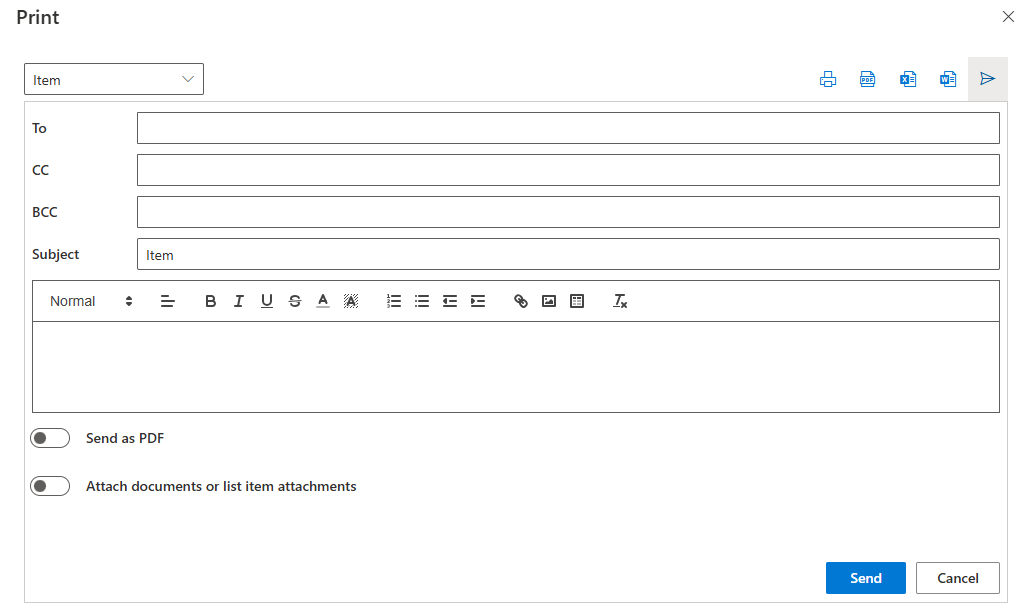
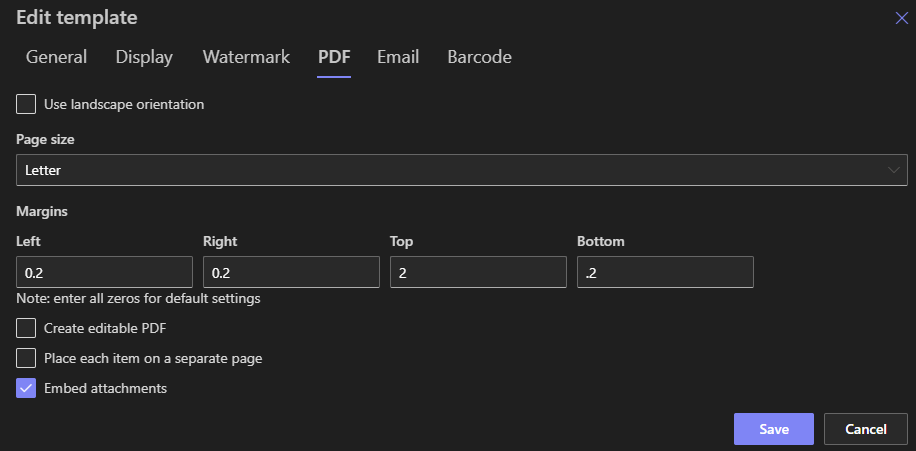
Embedding into the PDF. With PDF output and the Embed attachments option on, supported types become part of the generated file itself: PDF, Word, text, HTML, and images merge into the one document, the report with its photographed receipts as following pages. Unsupported types are not lost; they are delivered alongside, as separate email attachments, so the package stays complete either way:
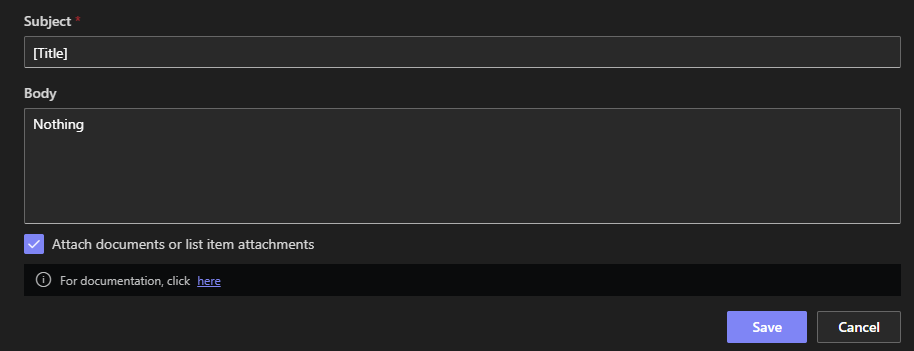
Through the print action. Automated generation, triggered by events or timers, carries the same capability: the Print List Items action's settings include the attachments, embedded into the PDF or delivered and stored alongside it depending on format and destination. The approval that generates and emails the contract sends its exhibits in the same motion, with no one assembling anything:
The embed-versus-alongside decision is mostly made by the recipient's situation. One merged PDF suits archives, regulators, and anyone who will file or forward the package as a unit, and it is the form PDF merge scenarios live on. Separate files suit recipients who need the originals, the editable spreadsheet, the source document, in their native formats.
Standard documents on every export
Item attachments differ per item; some documents must go with every item. Terms and conditions. Bank details for payments. The privacy notice, the warranty statement, the instructions. The Additional attachments capability handles exactly this: at the print template level, select any number of documents from the site's libraries, and that set accompanies every item printed through the template:
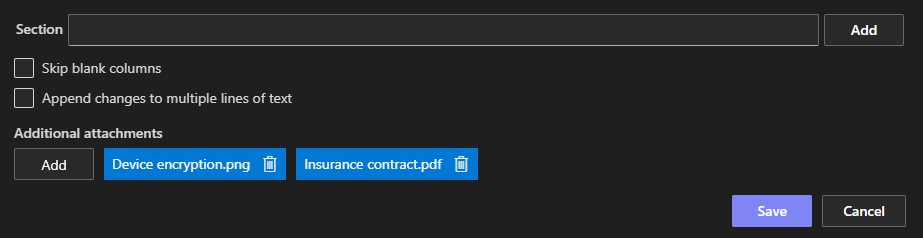
The mortgage package is the canonical example: the generated PDF carries the customer's specific mortgage details, and the additional attachments carry the standard accompaniments, payment bank details, terms and conditions, the required disclosures, identical for every customer, attached by configuration rather than by anyone remembering, which in regulated correspondence is precisely the guarantee the regulator wants to hear described. Additional attachments behave exactly like regular ones from there: embedded into the PDF where types allow, merged in the PDF-merge capacity, or delivered alongside.
One operational note keeps this reliable: the template references the selected documents by URL, and the documents continue to live in their library. Renaming or moving a referenced document breaks the reference, so the standard-documents library deserves the stability its role implies, updates by new version, not by new filename, which conveniently is also how a versioned terms-and-conditions document should be managed anyway.
Designing the package deliberately
Two design questions settle most attachment configurations before they are built. First, what is the recipient's single artifact? If the process files, submits, or audits one thing, embed toward one PDF, order matters less than completeness, and the merged file's size is the price of its unity, so keep the images compressed at the source and the evidence relevant. If the recipient works with the parts, the editable quote, the original spreadsheet, deliver alongside, and let the email carry the set.
Second, which documents are the item's and which are the process's? The receipts belong to this expense report; the reimbursement policy belongs to every expense report. Item-owned documents ride through the item's own attachments or Document Link; process-owned documents belong in the template's additional attachments, where one configuration serves every export and one version update refreshes every future package. Misplacing a process document onto items, copied to each one by hand or action, recreates the maintenance problem the capability exists to remove: fifty items carrying fifty copies of last year's terms.
The packages this builds
The evidence-complete report. Expense reports with receipts embedded, inspections with photos, incident records with the supporting images, one PDF, filed or submitted as the single artifact the process demands, with the parent-and-child consolidation covering the related-records dimension of the same completeness.
The regulated customer package. The personalized document plus its mandatory standard accompaniments, generated and emailed automatically on approval, with the additional-attachments set guaranteeing the compliance half of the package without a checklist.
The handover file. The contract with its exhibits, the order with its specifications, delivered to the counterparty as one complete package, which is the difference between correspondence and documentation, and the counterparty's first impression of how your organization keeps its records.
Across all three, the discipline is the one that runs through the whole printing cluster: decide the package once, in configuration, and let every subsequent export inherit the decision. Completeness, like formatting, should be a property of the template, not a virtue of whoever clicked Print.
Frequently asked questions
Add your comment